[Majorityrights Central] Three possible forms of a Ukrainian victory ... and a Russian defeat Posted by Guessedworker on Thursday, 16 April 2026 16:36.
[Majorityrights Central] Empires, the Chinese Mind, a theoretical nationalism of ethnicity Posted by Guessedworker on Saturday, 14 February 2026 01:54.
[Majorityrights News] Moscow Times: Valdai residents report no sign of drones attacking Putin residence Posted by Guessedworker on Tuesday, 30 December 2025 11:33.
[Majorityrights Central] Thoughts on Mark Collett’s strategy for nationalism in the British future Posted by Guessedworker on Friday, 24 October 2025 15:01.
[Majorityrights Central] Principles, parts, processes of ethnic nationalism, Part 1: inflection? Posted by Guessedworker on Thursday, 31 July 2025 12:03.
Posted by DanielS on Sunday, 12 February 2017 08:49.
TomDispatch: “Is President Trump Headed for a War with China?” All Options Are “On The Table” - Rajan Menon, 12 Feb 2017:
Forget those “bad hombres down there” in Mexico that U.S. troops might take out. Ignore the way National Security Adviser Michael Flynn put Iran “on notice” and the new president insisted, that, when it comes to that country, “nothing is off the table.” Instead, focus for a moment on something truly scary: the possibility that Donald Trump’s Washington might slide into an actual war with the planet’s rising superpower, China. No kidding. It could really happen.
Let’s start with silver-maned, stately Rex Tillerson, Donald Trump’s pick for secretary of state. Who could deny that the former ExxonMobil CEO has a foreign minister’s bearing? Trump reportedly chose him over neocon firebrand John Bolton partly for that reason. (Among other things, Bolton was mustachioed, something the new president apparently doesn’t care for.) But an august persona can only do so much; it can’t offset a lack of professional diplomatic experience.
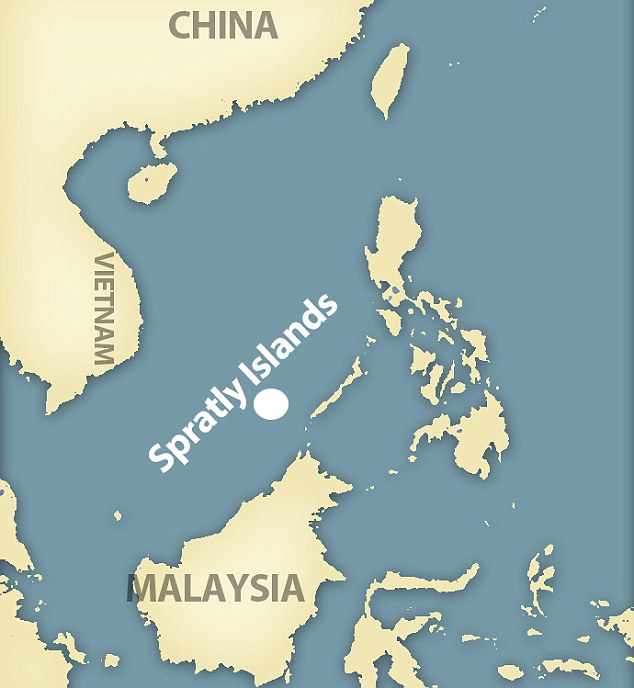
That became all-too-apparent during Tillerson’s January 11th confirmation hearing before the Senate Foreign Relations Committee. He was asked for his view on the military infrastructure China has been creating on various islands in the South China Sea, the ownership of which other Asian countries, including Taiwan, the Philippines, Vietnam, Malaysia, and Brunei claim as well . China’s actions, he replied, were “extremely worrisome,” likening them to Russia’s annexation of Ukraine’s Crimean peninsula, an infraction for which Russia was slapped with economic sanctions.
The then-secretary-of-state-designate — he’s since been confirmed, despite many negative votes — didn’t, however, stop there. Evidently, he wanted to communicate to the Chinese leadership in Beijing that the new administration was already irked beyond measure with them. So he added, “We’re going to have to send China’s leaders a clear signal: that, first, the island building stops and, second, your access to those islands is not going to be allowed.” Functionally, that fell little short of being an announcement of a future act of war, since not allowing “access” to those islands would clearly involve military moves. In what amounted to a there’s-a-new-sheriff-in-town warning, he then doubled down yet again, insisting, slightly incoherently (in the tradition of his new boss) that “the failure of a response has allowed them to just keep pushing the envelope on this.”
All right, so maybe a novice had a bad day. Maybe the secretary-of-state-to-be simply ad-libbed and misspoke… whatever. If so, you might have expected a later clarification from him or from someone on the Trump national security team anyway.
That didn’t happen; instead, that team stuck to its guns. White House Press Secretary Sean Spicer made no effort to add nuance to, let alone walk back, Tillerson’s remarks. During his first official press briefing on January 23rd, Spicer declared that the United States “is going to make sure we defend our interests there” — in the South China Sea, that is — and that “if those islands are in fact in international waters and not part of China proper, then yes, we are going to make sure that we defend international territories from being taken over by one country.”
And what of Trump’s own views on the island controversy? Never one to pass up an opportunity for hyperbole, during the presidential campaign he swore that, on those tiny islands, China was building “a military fortress the likes of which the world has not seen.” As it happened, he wasn’t speaking about, say, the forces that Hitler massed for the ill-fated Operation Barbarossa, launched in June 1941 with the aim of crushing the Red Army and the Soviet Union, or those deployed for the June 1944 Normandy landing, which sealed Nazi Germany’s fate. When applied to what China has been up to in the South China Sea, his statement fell instantly into the not-yet-named category of “alternative facts.”
Candidate Trump also let it be known that he wouldn’t allow Beijing to get away with such cheekiness on his watch. Why had the Chinese engaged in military construction on the islands? Trump had a simple answer (as he invariably does): China “has no respect for our president and no respect for our country.” The implication was evident. Things would be different once he settled into the White House and made America great again. Then — it was easy enough to conclude — China had better watch out.
Standard campaign bombast? Well, Trump hasn’t changed his tune a bit since being elected. On December 4th, using (of course!) his Twitter account, he blasted Beijing for having built “a massive military complex in the middle of the South China Sea.” And it’s safe to assume that he signed off on Spicer’s combative comments as well.
In short, his administration has already drawn a red line — but in the way a petulant child might with a crayon. During and after the campaign he made much of his determination to regain the respect he claims the U.S. has lost in the world, notably from adversaries like China. The danger here is that, in dealing with that country, Trump could, as is typical, make it all about himself, all about “winning,” one of his most beloved words, and disaster might follow.
A military clash between Trump-led America and a China led by President Xi Jinping? Understanding how it might happen requires a brief detour to the place where it’s most likely to occur: the South China Sea. Our first task: to understand China’s position on that body of water and the islands it contains, as well as the nature of Beijing’s military projects there. So brace yourself for some necessary detail.
As Marina Tsirbas, a former diplomat now at the Australian National University’s National Security College, explains, Beijing’s written and verbal statements on the South China Sea lend themselves to two different interpretations. The Chinese government’s position boils down to something like this: “We own everything — the waters, islands and reefs, marine resources, and energy and mineral deposits — within the Nine-Dash Line.” That demarcation line, which incidentally has had ten dashes, and sometimes eleven, originally appeared in 1947 maps of the Republic of China, the Nationalist government that would soon flee to the island of Taiwan leaving the Chinese Communists in charge of the mainland. When Mao Ze Dong and his associates established the People’s Republic, they retained that Nationalist map and the demarcation line that went with it, which just happened to enclose virtually all of the South China Sea, claiming sovereign rights.
This stance — think of it as Beijing’s hard line on the subject — raises instant questions about other countries’ navigation and overflight rights through that much-used region. In essence, do they have any and, if so, will Beijing alone be the one to define what those are? And will those definitions start to change as China becomes ever more powerful? These are hardly trivial concerns, given that about $5 trillion worth of goods pass through the South China Sea annually.
Then there’s what might be called Beijing’s softer line, based on rights accorded by the legal concepts of the territorial sea and the Exclusive Economic Zone (EEZ). Under the U.N. Convention on the Law of the Sea (UNCLOS), which took effect in 1994 and has been signed by 167 states (including China but not the United States), a country has sovereign control within 12 nautical miles of its coast as well as of land formations in that perimeter visible at high tide. But other countries have the right of “innocent passage.” The EEZ goes further. It provides a rightful claimant control over access to fishing, as well as seabed and subsoil natural resources , within “an area beyond and adjacent to the territorial sea” extending 200 nautical miles, while ensuring other states’ freedom of passage by air and sea. UNCLOS also gives a state with an EEZ control over “the establishment and use of artificial islands, installations, and structures” within that zone — an important provision at our present moment.
What makes all of this so much more complicated is that many of the islands and reefs in the South China Sea that provide the basis for defining China’s EEZ are also claimed by other countries under the terms of UNCLOS. That, of course, immediately raises questions about the legality of Beijing’s military construction projects in that watery expanse on islands, atolls, and strips of land it’s dredging into existence, as well as its claims to seabed energy resources, fishing rights, and land reclamation rights there — to say nothing about its willingness to seize some of them by force, rival claims be damned.
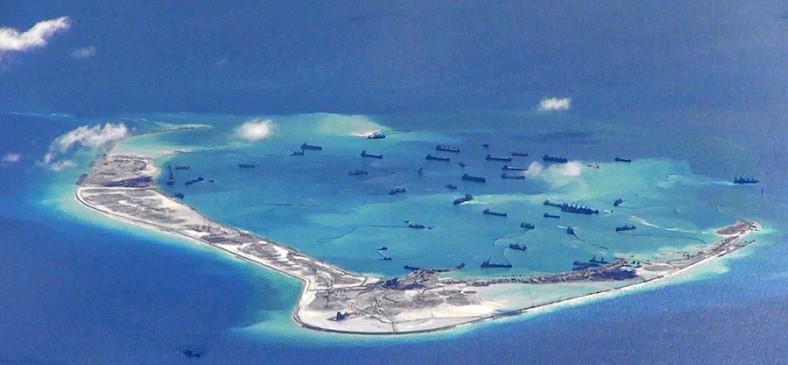
Subi Reef, being built into an artificial island-landing strip in 2015
Moreover, figuring out which of these two positions — hard or soft — China embraces at any moment is tricky indeed. Beijing, for instance, insists that it upholds freedom of navigation and overflight rights in the Sea, but it has also said that these rights don’t apply to warships and military aircraft. In recent years its warplanes have intercepted, and at close quarters, American military aircraft flying outside Chinese territorial waters in the same region. Similarly, in 2015, Chinese aircraft and ships followed and issued warnings to an American warship off Subi Reef in the Spratly Islands, which both China and Vietnam claim in their entirety. This past December, its Navy seized, but later returned, an underwater drone the American naval ship Bowditch had been operating near the coast of the Philippines.
There were similar incidents in 2000, 2001, 2002, 2009, 2013, and 2014. In the second of these episodes, a Chinese fighter jet collided with a US Navy EP-3 reconnaissance plane, which had a crew of 24 on board, less than 70 miles off Hainan island, forcing it to make an emergency landing in China and creating a tense standoff between Beijing and Washington. The Chinese detained the crew for 11 days. They disassembled the EP-3, returning it three months later in pieces.
Such muscle flexing in the South China Sea isn’t new. China has long been tough on its weaker neighbors in those waters. Back in 1974, for instance, its forces ejected South Vietnamese troops from parts of the Paracel/Xisha islands that Beijing claimed but did not yet control. China has also backed up its claim to the Spratly/Nansha islands (which Taiwan, Vietnam, and other regional countries reject) with air and naval patrols, tough talk, and more. In 1988, it forcibly occupied the Vietnamese-controlled Johnson Reef, securing control over the first of what would eventually become seven possessions in the Spratlys.
Vietnam has not been the only Southeast Asian country to receive such rough treatment. China and the Philippines both claim ownership of Panatag (Scarborough) Shoal/Huangyang Island, located 124 nautical miles off Luzon Island in the Philippines. In 2012, Beijing simply seized it, having already ejected Manila from Panganiban Reef (aka Mischief Reef), about 129 nautical miles from the Philippines’ Palawan Island, in 1995. In 2016, when an international arbitration tribunal upheld Manila’s position on Mischief Reef and Scarborough Shoal, the Chinese Foreign Ministry sniffed that “the decision is invalid and has no binding force.” Chinese president Xi Jinping added for good measure that China’s claims to the South China Sea stretched back to “ancient times.”
Then there’s China’s military construction work in the area, which includes the building of full-scale artificial islands, as well as harbors, military airfields, storage facilities, and hangars reinforced to protect military aircraft. In addition, the Chinese have installed radar systems, anti-aircraft missiles, and anti-missile defense systems on some of these islands.
These , then, are the projects that the Trump administration says it will stop. But China’s conduct in the South China Sea leaves little doubt about its determination to hold onto what it has and continue its activities. The Chinese leadership has made this clear since Donald Trump’s election, and the state-run press has struck a similarly defiant note, drawing crude red lines of its own. For example, the Global Times, a nationalist newspaper, mocked Trump’s pretensions and issued a doomsday warning: “The U.S. has no absolute power to dominate the South China Sea. Tillerson had better bone up on nuclear strategies if he wants to force a big nuclear power to withdraw from its own territories.”
Were the administration to follow its threatening talk with military action, the Global Times added ominously, “The two sides had better prepare for a military clash.” Although the Chinese leadership hasn’t been anywhere near as bombastic, top officials have made it clear that they won’t yield an inch on the South China Sea, that disputes over territories are matters for China and its neighbors to settle, and that Washington had best butt out.
Posted by DanielS on Thursday, 09 February 2017 08:16.
Visigrad Post, “Central Europe Unites to Put an End to Illegal Immigration” 9 Feb 2017:
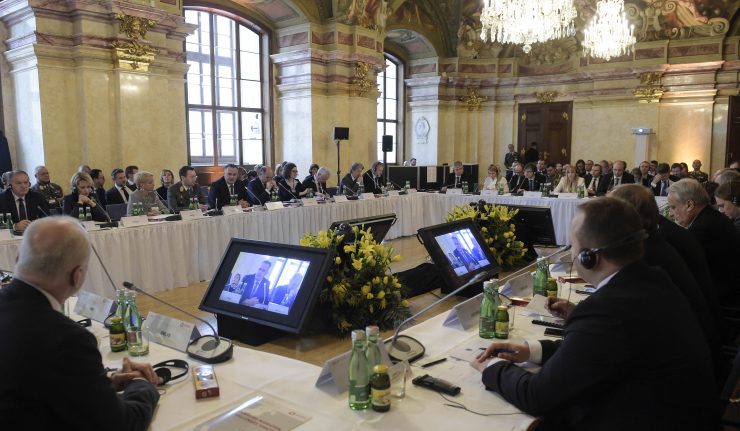
Austria, Vienna – Ministers from 15 countries gathered in Vienna on Wednesday, February 8, in order to find a common way to put an end to the illegal immigration in the Balkans and Central Europe.
Representatives from Austria, Hungary, Bulgaria, Czechia, Croatia, Poland, Romania, Slovakia, Slovenia, Albania, Bosnia, Montenegro, Macedonia, Serbia, Kosovo, and Greece, as well as officials of the Central European Defence Cooperation took part at the meeting.
Countries along the Balkan migration route agreed on Wednesday to seal the already hard borders and prevent a possible new surge of people trying to reach wealthy EU countries. Since the countries on the Balkans’ route already secured their borders a year ago, the number of illegal immigrants has dramatically dwindled, but hundreds of migrants still try each month to take this route.
A plan to plug the remaining gaps on the route from Greece to Austria and Germany is to be drawn up by April, defence and interior ministers from affected countries decided at a conference in Vienna.
The agreement anticipates the potential collapse of the EU‘s deal with Turkey to keep migrants and refugees.
American tech companies are gearing up to protect the thousands of workers they rely on every year who aren’t U.S. citizens and don’t have green cards.
Silicon Valley has aggressively backed legislation to protect and expand the H-1B program for temporary workers, but President Trump appears to have other ideas. He is reportedly preparing to sign a new immigration-related executive order that includes an effort to overhaul the H-1B visa program, putting in place protectionist rules that would upend the way Silicon Valley recruits talent.
Tech leaders have been warning of a “brain drain” since Election Day — and now there’s talk of companies moving employees to Canada.
A leaked draft of the executive order disseminated by Vox featured vague wording, calling for plans to “alter” the H-1B visa program, although experts point out that such changes would require an act of Congress. The draft order also discusses reforming programs that allow foreign students into the U.S. — since they pay full price, they’re an important source of tuition dollars for top-flight public universities — before then entering the American workforce.
A spokesperson for the United States Citizenship and Immigration Services, which is part of the Department of Homeland Security, said that USCIS does not comment on pending legislation or executive actions.
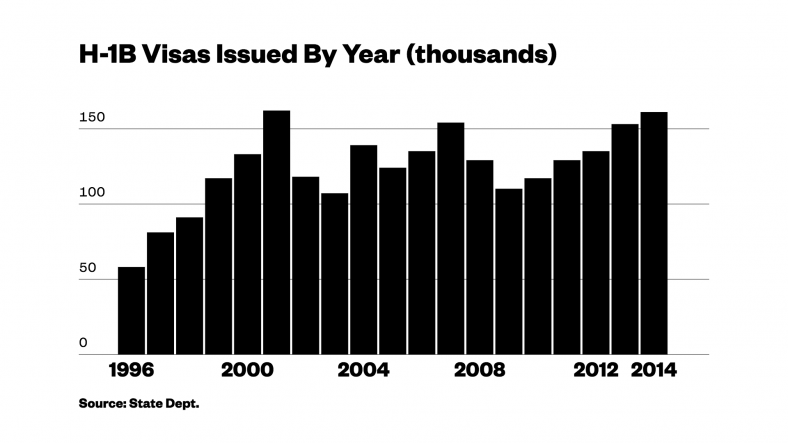
Designed as a temporary visa for skilled workers, the H-1B became a way for corporate America to bring in highly skilled foreigners without having to tackle the permanent resident program — i.e., green cards, which are capped by country of origin, a rule that disproportionately affects places like China and India. When the program was introduced in 1990, about 800 H-1Bs were issued. By 2014, that number had grown to more than 160,000.
Both Republicans and Democrats are now pushing for reform of the program, ostensibly in order to protect U.S. workers.
GOP opposition to the H-1B in particular has been mounting for some time, but Republican politicians have generally been wary of either stifling some of America’s most successful companies or taking on immigration reform and infuriating the party’s anti-immigration base. Not all Republican politicians, however; in 2015, Alabama Sen. Jeff Sessions — Trump’s nominee for Attorney General — introduced bipartisan legislation aimed at curtailing the number of visas given out.
A recent bipartisan effort to tackle the issue took the form of a Senate bill introduced by Iowa Republican Chuck Grassley and Illinois Democrat Dick Durbin that aimed to reform the program by creating higher salary floors for H-1B visas and making sure U.S. workers are given first dibs on potential H-1B jobs.
Two of Trump’s top advisers who reportedly crafted the refugee ban — ex-Breitbart CEO Steve Bannon and former Sessions adviser Stephen Miller — have also taken aim at Silicon Valley in the past. Earlier in January, Miller is said to have proposed both completely scrapping the lottery system used to award H-1B visas and increasing the minimum salary companies must pay visa holders in order to prevent the undercutting of more expensive American labor. Before Bannon was tapped as Trump’s campaign chief, he suggested in a 2015 interview with Trump that “when two-thirds or three-quarters of the CEOs in Silicon Valley are from South Asia or from Asia,” it could undermine “civic society.”
Silicon Valley says in no uncertain terms that its success is due in part to its meritocratic embrace of anybody from anywhere who has the talent to compete. As Google CEO Sundar Pichai, who emigrated to the U.S. from India, told columnist Walt Mossberg, “In Silicon Valley, being an immigrant doesn’t matter. It’s the ideas that matter. We are able to build products for everyone because we attract talent from around the world.”
Posted by DanielS on Thursday, 02 February 2017 05:54.
TNO, “Germany: 99.9% of Invaders Will Stay”, 2 Feb 2017
Contrary to German government claims that “refugees” will go home once there is “peace in their countries,” new statistics show that only one out of every 1,000 invaders granted “asylum” are ever refused permanent residence.
According to an investigation by Die Welt newspaper, “almost all refugees are allowed to stay permanently” in Germany, even those who were only initially granted “temporary subsidiary protection.”
The investigation revealed that the latest figures from the Federal Office for Migration and Refugees (BAMF) proved that in 99 percent of cases, once anyone had been recognized as a “refugee,” they could remain permanently in Germany.
According to the Geneva Convention, the report continued, “asylum and refugee protection are granted for a limited period of three years.”
However, after the expiration of this period, those granted “protection” are then almost always given indefinite leave to remain, Die Welt revealed.
..after which time they are in position to spread to other parts of Europe.
“Meet the top Jewish officials in the Trump Administration”
American Jews are watching the beginning of Donald Trump’s presidency with both fear and hope. Many have expressed worries about some of his supporters’ ties to the so-called “alt-right” movement, whose followers traffic variously in white nationalism, anti-immigration sentiment, anti-Semitism and a disdain for “political correctness.” Those fears intensified when Trump named as his chief strategist Stephen Bannon, the former chairman of Breitbart News, a site Bannon once referred to as a “platform” of the alt-right. Trump’s strongly conservative Cabinet picks also back policies on health care, the environment, abortion and civil rights often diametrically opposed to the views of most Jewish voters.
Yet others have praised Trump’s stance on Israel and his nomination of David Friedman, a bankruptcy lawyer who supports West Bank settlement construction and has expressed doubts about the two-state solution, as US ambassador to Israel. Trump won 24% of the Jewish vote, with especially strong support in the Orthodox community.
(Trump: “We have to protect Israel”)
Here is a look at the president’s Jewish advisers who will be helping to shape US policy for the next four years.
Jared Kushner
Trump’s Orthodox son-in law is serving as a senior adviser to the president. Kushner, the 36-year-old scion of a prominent real estate family from New Jersey, will not receive a salary and will focus on the Middle East and Israel as well as partnerships with the private sector and free trade, according to The New York Times. A day before his appointment was announced, Kushner said he would step down from his role as CEO of his family firm, Kushner Properties.
Kushner, who married Trump’s daughter Ivanka in 2009, played a crucial role in the president’s campaign, especially on Israel. He worked on Trump’s speech to the AIPAC annual policy conference that earned the real estate mogul a standing ovation, and helped plan a trip to Israel for his father-in-law in 2016 (Trump canceled the trip after Prime Minister Benjamin Netanyahu slammed his call to ban Muslim immigration to the United States).
Trump appears to be smitten with Kushner, often referring to his “fantastic” son-in-law when boasting of his pro-Israel credentials.
Kushner may have become a household name during the campaign, but he’s no stranger to the limelight. In 2006, at 25, he bought the New York Observer newspaper. Two years later he became CEO of Kushner Properties, four years after his father was sent to jail for tax evasion, illegal campaign donations and witness tampering. In 2015, Fortune named Kushner to its 40 Under 40 list, an “annual ranking of the most influential young people in business.”
Stephen Miller
Trump named Miller, who has played a crucial role in his campaign by writing speeches and warming up crowds at rallies, as senior adviser for policy.
Miller, who has described himself as “a practicing Jew,” joined the Trump campaign in early 2016, quickly rising through the ranks to become “one of the most important people in the campaign,” as Trump’s campaign manager told The Wall Street Journal.
Previously the 31-year-old worked for seven years as an aide to Trump’s choice for attorney general, Sen. Jeff Sessions, R-Ala., helping the lawmaker draft materials to kill a bipartisan Senate immigration reform bill. Some of Sessions’ arguments are similar to the harsh and often controversial statements by Trump on the issue, such as calling for building a wall on the Mexican border and banning Muslim immigration to the US.
Though Miller grew up in a liberal Jewish home in Southern California, he was drawn to conservative causes early. As a high school student he wrote a letter to the editor of a local paper in which he slammed his school for providing free condoms to students and for making announcements both in English and Spanish, among other things.
Carl Icahn
Icahn, a businessman and investor, is serving as a special adviser on regulatory reform issues. He is working as a private citizen rather than a federal employee or special government employee.
An early supporter of Trump’s candidacy, Icahn, 80, is the founder of Icahn Enterprises, a diversified conglomerate based in New York City formerly known as American Real Estate Partners. He has also held substantial or controlling positions in numerous American companies over the years, including RJR Nabisco, Texaco, Philips Petroleum, Western Union, Gulf & Western, Viacom, Revlon, Time Warner, Motorola, Chesapeake Energy, Dell, Netflix, Apple and eBay.
Icahn is a major giver to Mount Sinai hospital in New York City, among other philanthropic endeavors. In 2012, he donated $200 million to the renamed Icahn School of Medicine there.
In addition, Icahn established seven Icahn Charter Schools in the Bronx borough of New York.
Steven Mnuchin
Trump picked Mnuchin, a former Goldman Sachs executive who worked as Trump’s national finance chairman during the campaign, to serve as Treasury secretary.
Trump and Mnuchin have been friends for 15 years, and prior to being in charge of Trump’s campaign finances, Mnuchin, 54, served as an adviser. Part of what The New York Times describes as one of Manhattan’s “most influential families,” Mnuchin and his father — the prominent art dealer Robert Mnuchin — both became wealthy working at Goldman Sachs. The younger Mnuchin also co-founded the entertainment company RatPac-Dune Entertainment, which has worked on such Hollywood hits as “Avatar” and “Black Swan.”
Some saw Trump teaming up with Mnuchin as unusual, considering that the real-estate mogul had consistently bashed Goldman Sachs during his campaign — but it doesn’t seem to have hindered a good working relationship.
Boris Epshteyn
Epshteyn, a Republican political strategist who appeared as a Trump surrogate on TV, is working as a special assistant to the president. Epshteyn, who is in his mid-30s, also is serving as assistant communications director for surrogate operations.
A New York-based investment banker and finance attorney, Epshteyn was a communications aide for Sen. John McCain’s presidential campaign in 2008, focusing his efforts on the Arizona senator’s running mate, then-Alaska Gov. Sarah Palin.
He defended Trump on major TV networks over 100 times, according to The New York Times. TV hosts have described Epshteyn, who moved to the United States from his native Moscow in 1993, as “very combative” and “abrasive.”
In 2014, he was charged with misdemeanor assault after being involved in a bar tussle. The charge was dropped after Epshteyn agreed to undergo anger management training and perform community service.
Gary Cohn
Cohn, the outgoing president and chief operating officer at Goldman Sachs, heads the White House National Economic Council. At Goldman Sachs, where he had worked since 1990, Cohn answered to CEO Lloyd Blankfein and was considered a strong candidate to lead the bank.
The 56-year-old father of three has a reputation for abrasiveness, but also for getting things done, according to a Wall Street Journal profile last year. In a 2014 New York Times op-ed, Goldman Sachs executive Greg Smith wrote on the day he resigned that Blankfein and Cohn were responsible for a “decline in the firm’s moral fiber” that placed its interests above those of its clients.
Cohn, a Cleveland native, in 2009 funded the Cohn Jewish Student Center at Kent State University named for his parents.
Success wasn’t always obvious for Cohn, whose struggle with dyslexia made school difficult for him. But the Goldman Sachs banker, who was featured in a book on underdogs by writer Malcolm Gladwell, told the author that his learning disability also taught him how to deal with failure and that “I wouldn’t be where I am today without my dyslexia.”
Posted by DanielS on Tuesday, 31 January 2017 09:28.
Breitbart, “Pro-Life Leaders on Judge Gorsuch’s Nomination
- Donald Trump ‘A Man of His Word”, 31 Jan 2017:
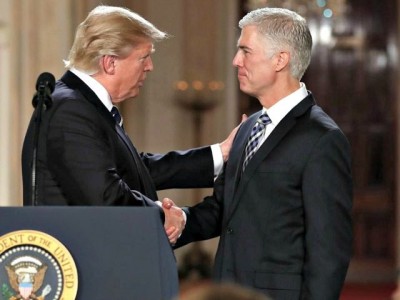
National pro-life leaders are applauding President Donald Trump’s Supreme Court pick, Judge Neil Gorsuch of the Tenth Circuit, to take the seat of the late Justice Antonin Scalia.
“We want to express our thanks to President Trump for nominating a man of such stellar quality as Neil Gorsuch to the Supreme Court,” said Operation Rescue president Troy Newman. “One of the reasons I endorsed Trump for president was because of the strong promises he made to pro-life leaders. Now, after less than two weeks in office, he is keeping those promises, and we are very encouraged. He has proved himself to be a man of his word.”
“The nomination of Judge Neil Gorsuch to the United States Supreme Court is a tremendous victory for religious freedom and, indeed, for the entire nation,” said Father Frank Pavone, national director of Priests for Life. “His reasoned opinions in decisions upholding the rights of groups who — like Priests for Life — have challenged the Obama administration’s HHS mandate show that he respects the rights of Americans of all beliefs. His statements in favor of upholding the Constitution are totally in line with those of the late Justice Antonin Scalia. President Trump has made an excellent choice.”
Regarding the nomination of Gorsuch, Leonard A. Leo, Trump’s Supreme Court Advisor, said the announcement fulfilled the promise the president made to the American people.
“Judge Gorsuch possesses keen intellect, independence of judgment, integrity, courage, and a sense of fairness that is grounded in the Constitution and laws as they are written,” Leo said in a statement. “This is what the President very much wanted in a nominee.”
“Under our Constitution, power ultimately rests with the people,” he added. “This ideal is at the core of Justice Scalia’s legacy. As we heard from President Trump’s inauguration speech, it is at the core of the President’s agenda, and it’s very much at the core of what Neil Gorsuch’s record is as a jurist.”
Rep. Diane Black (R-TN), a member of the Congressional Pro-Life Caucus, reacted to Gorsuch’s nomination in a statement:
I applaud President Trump for nominating a fair-minded Constitutionalist like Judge Gorsuch to serve on our highest court. With this selection, President Trump has chosen a respected jurist who will uphold both the spirit and the letter of our law. I am especially encouraged by Judge Gorsuch’s opinions in the cases of Hobby Lobby vs. Sebelius and Little Sisters of the Poor vs. Burwell, which display a clear respect for religious freedom that has been missing in too many corners of Washington over the last eight years. He is uniquely qualified for this role, having already been confirmed without opposition to the Tenth Circuit Court of Appeals by the US Senate in 2006, and I know that he will be a worthy successor to the esteemed legacy of Justice Antonin Scalia.
Family Research Council president Tony Perkins attended the White House announcement. He said in a statement:
I was pleased to witness President Trump follow through on his promise and select a nominee from the list he presented during the campaign. The president has been very clear on the type of justices that he would appoint: textualists who will not issue rulings based on the shadows of the Constitution.
Judge Gorsuch’s record over the last 14 years, especially on religious liberty, gives Americans every reason to believe he will make a fine Supreme Court justice. His reputation as a judge with integrity and dedication to the Constitution should be an encouragement to all Americans.
Kristan Hawkins, president of Students for Life of America, the nation’s largest pro-life youth organization, said:
We are thrilled with Judge Neil Gorsuch’s nomination to the US Supreme Court by President Trump, who is continuing to fulfill campaign promises at a breakneck speed. A strict Constitutionalist and firm supporter of religious freedom and liberties dictated by the Founding Fathers, Judge Gorsuch is an excellent replacement for the late Justice Scalia, and one who has the potential to leave a powerful legacy.
The Supreme Court was of great concern to voters this past November and the Senate should take swift action to confirm Judge Gorsuch to the high Court to ensure a full slate of Justices. The Senate unanimously confirmed Judge Gorsuch to the 10th US Circuit of Appeals and they should follow their previous example. We aren’t tired of winning yet.
Posted by DanielS on Wednesday, 25 January 2017 03:44.
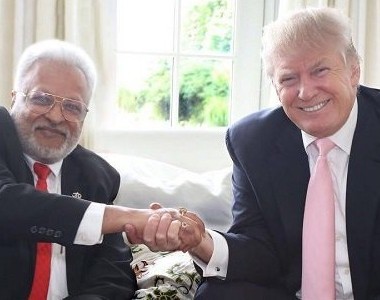
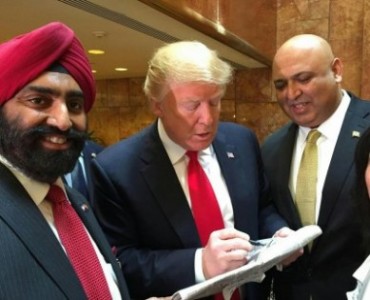
“Don’t be surprised if the money he used to buy-up American real estate came from U.S. foreign aid” - TT. Pictured, Trump signalng 181 dimensional chess with Pakistani-American real estate tycoon, Sajid Tarahas, founder of ‘Muslims for Trump.’
BBC, “Trump’s Hindu, Sikh and Muslim power brokers”, 24 Jan 2017:
When Indian-American industrialist Shalabh “Shalli” Kumar donated close to a million dollars to the Trump campaign, many in the community dismissed it as a poor investment.
But today, Mr Kumar is the go-to guy not just for Indian-Americans chasing opportunities in the new administration but apparently for the Indian officials seeking contacts with Trump aides.
A leading Indian TV channel NDTV introduced him as “the man with a direct line to Trump” on their show. Another top-ranking Diaspora website, The American Bazar, has called him “the most influential Indian-American power broker” in DC.
And Kumar isn’t complaining about this new celebrity status. “I would like to be the bridge between the two sides,” he told the BBC. “I have arranged two big meetings between Indian officials and leading figures in the Trump team.”
A majority in the Indian immigrant community have traditionally supported Democrats and Trump’s anti-immigrant campaign rhetoric seemed to have further alienated many.
Kumar says he and his Republican Hindu Coalition mobilised Hindu Indian-Americans votes in swing states like Florida.
Their message? Trump was the anti-terrorism candidate, and would help India and US see greater collaboration in defence, energy and manufacturing.
Trump’s anti-Muslim rhetoric did appeal to some Hindus, but whether that actually swayed the community at large is unclear.
Kumar is not the only one whose stock has soared with a Trump victory.
Pakistani-American Sajid Tarar, who is a Muslim, and Sikh-American Jesse Singh, sided with Mr Trump at the peak of his anti-Muslim barbs. They were pilloried by their own communities for doing so. One exit poll suggested more than three-quarters of Muslims voted for Clinton.
Mr Tarar’s Facebook inbox used to be swamped with negative messages, calling him a “disgrace to Pakistan and Islam”.
But on the morning of 9 November, his phone wouldn’t stop ringing. Mr Tarar had more than 80 messages congratulating him on Mr Trump’s victory and how he had made Pakistan proud.
He says the Pakistan embassy reached out to him to facilitate a call between Pakistani Prime Minister Nawaz Sharif and the President-elect.
“I sent out a few emails and the call happened,” says Mr Tarar, a real estate businessman.